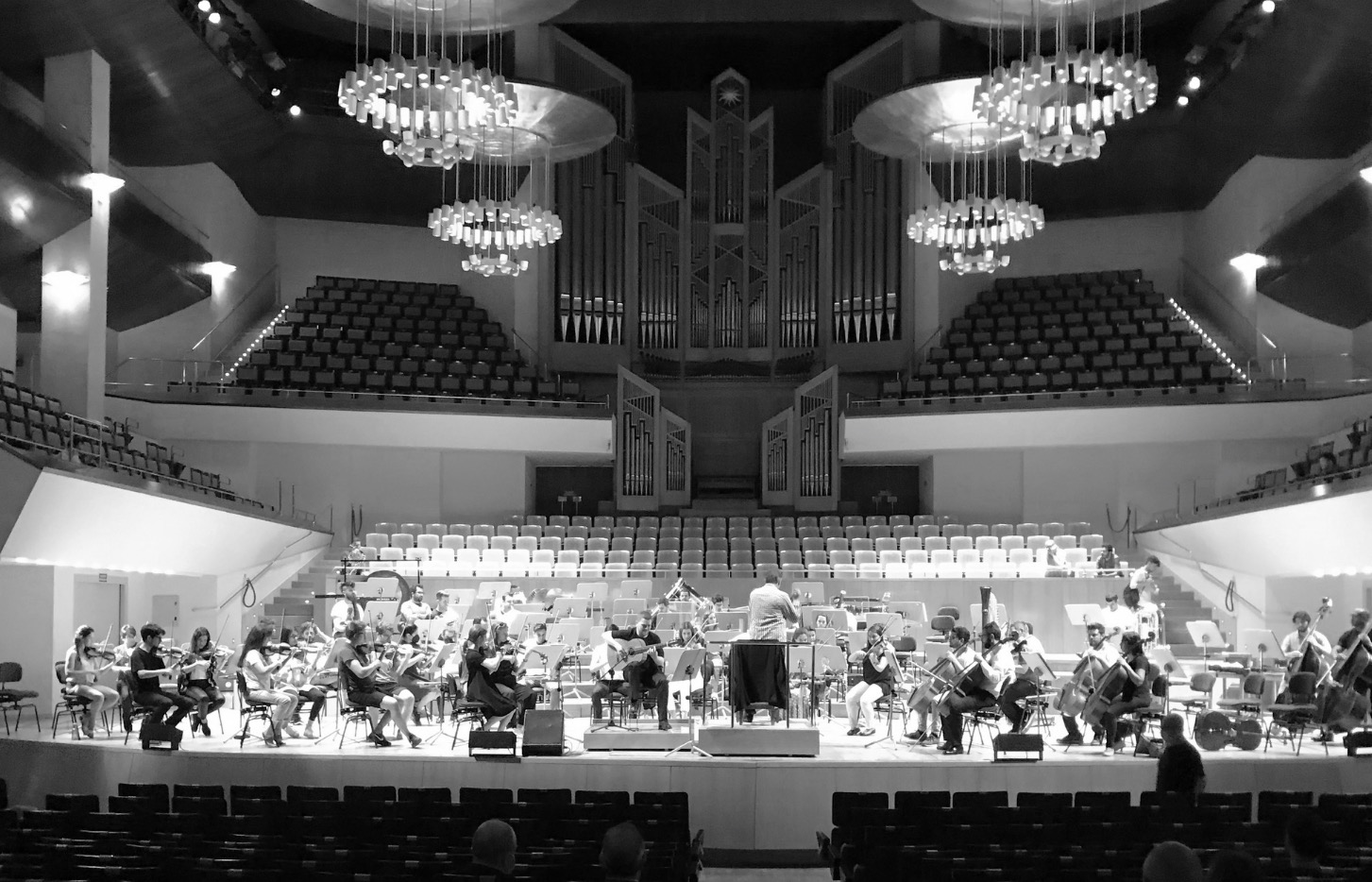
JOAQUÍN RODRIGO: ARANJUEZ CONCERTO
If there is a representative work for guitar accompanied by an orchestra, it is undoubtedly Joaquín Rodrigo's Concierto de Aranjuez. Since its premiere in Barcelona in 1940, classical guitarists have included it in their repertoire (with the notable exception of Andrés Segovia), making it by far the most performed concerto for guitar and orchestra in history.
50 years after its premiere, the brilliant Paco de Lucía decided to interpret it, thereby paving the way for flamenco guitarists to also incorporate this work into their repertoire. However, the characteristics of the score make it not accessible to everyone.
Alejandro Hurtado, a guitarist who thoroughly masters both flamenco and classical styles, offers us a new and refreshing version of this wonderful piece. While remaining faithful to Rodrigo's written score, he adds his personal touch in terms of phrasing, dynamics, and sonorities, breathing new life into this nearly century-old composition.
Some of the notable venues where he has performed it include the Teatro Real and the Auditorio Nacional in Madrid, as well as the Gran Teatro de Córdoba, receiving an enthusiastic response from the audience on every occasion.
SALVADOR BACARISSE: ROMANCE
Bacarisse, a Spanish composer who went into exile in Paris in 1939, composed his "Concertino for Guitar and Orchestra" in the French city in 1957, which would eventually become his most well-known work.
Of the three movements it consists of, the second, "Romanza," has gained the most popularity and is often performed separately from the rest of the concerto. It is a piece filled with melancholy, nostalgia, and deep emotion.
Considered by many as one of the most beautiful works in the classical music repertoire, it was inspired by the feelings the composer experienced due to being far away from his home country, to which he could never return. Its beauty and expressive power can evoke in anyone memories of happier times that can never be relived.
In this movement, the guitar transitions from having the melodic lead, presenting the themes, to being an instrument that accompanies the orchestra through a series of arpeggiated chords. Only someone with the sensitivity and technique of Alejandro Hurtado can extract all the beauty from this music and convey to the audience the emotions it inspires.
SABICAS / MORENO TORROBA: FLAMENCO CONCERTO
The four movements that make up this concerto (fandangos, seguiriyas, alegrías, and bulerías) are an orchestration created in 1961 by Federico Moreno Torroba, based on four of the pieces that maestro Sabicas had recorded on his album "Flamenco Puro." Interestingly, this concerto was never performed by Sabicas himself. Instead, the orchestral parts composed by Moreno Torroba and recorded by the Orquesta de Conciertos de Madrid (conducted by the composer himself) were mixed in the studio with fragments from Sabicas's "Flamenco Puro" album.
Moreno Torroba, well-known for his zarzuelas but also with an extensive body of work for classical guitar, including concertos with orchestra, demonstrates his masterful orchestration skills in this work. Despite the artificial nature of the composition, both the guitar and the orchestra shine, delivering one of the most interesting pieces for flamenco guitar and orchestra, and the first of its kind.
On this occasion, Alejandro Hurtado showcases his flamenco side. With his spectacular mastery of technique, he handles all the complexities presented in the works of one of the greatest virtuosos of concert flamenco guitar. Moreover, he demonstrates his profound understanding of the resources of the old flamenco masters, respecting the musical style of the pieces he interprets while adding his personal touch.
SABICAS / COFINER: GYPSY CONCERTO
In 1975, during Sabicas's stay in Spain, he crossed paths with the composer Enrique Escudé Cofiner. Sabicas recorded four of his own compositions, and based on them, Cofiner completed the work in July 1976, which he named "Gypsy Concerto," consisting of four movements:
Guajira
Soleá
Rondeña
Zapateado
Cofiner, the son of a flamenco guitarist and himself a great enthusiast, composed the orchestral parts over Sabicas's four pieces, creating introductions and connecting sections while adding orchestral harmony to support the guitar sounds.
Unlike the "Concierto en Flamenco" by Moreno Torroba, the Gypsy Concerto was never performed during Sabicas's lifetime, and it had to wait until 1993 for its first and only public performance. In this case, unlike the "Concierto en Flamenco," there is no recording of the concerto, making it entirely unknown to the public.
An interpretation of this concerto by Alejandro is scheduled for October 2023 in Barcelona.
RODRIGO / FANTASY FOR A GENTLEMAN
Composed in 1954 at the request of Andrés Segovia, Maestro Rodrigo's Fantasía para un Gentilhombre is his most popular concerto after the Concierto de Aranjuez.
The concerto is based on themes by the 17th-century Spanish guitarist Gaspar Sanz, keeping the names of the original pieces and attempting to adapt their spirit to the language of the 20th century: "A whole past of dances, in which old and new times finally connect, comes to life in these titles. I set out to ensure that the harmonic language and the sound atmosphere did not obstruct the spirit of those titles."